"I am the way and the truth and the life. No one comes to the father except through me." [John 14:6]

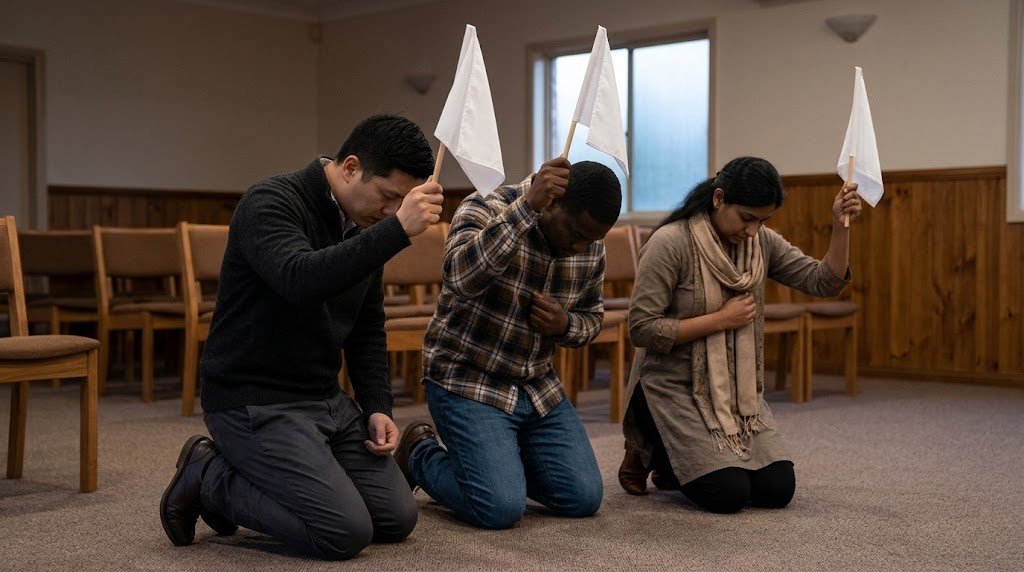
Did You Fully Surrender?
To look at total surrender I want to use two parables that you might not immediately consider on this subject:
“The kingdom of heaven is like treasure hidden in a field, which a man found and covered up. Then in his joy he goes and sells all that he has and buys that field.
“Again, the kingdom of heaven is like a merchant in search of fine pearls, who, on finding one pearl of great value, went and sold all that he had and bought it. Matthew 13:44–46
For centuries, commentaries have read extra details into the twin parables of. We are told the first man was a day-laborer who stumbled on buried coin by accident, while the second was an aristocratic merchant. From other sources, we are told one represents the Gentiles who were not looking, and the other represents Israel who was.
Maybe one or both views have merit. However, when you look at the raw Greek text, none of that is explicitly stated.
Setting aside traditional assumptions leaves us with the bare mechanics of what Jesus actually said. Both parables describe two people encountering the Kingdom, and both liquidate their lives to obtain it.
The Moment of Evaluation: Counting the Cost
In both accounts, discovery immediately forces a clear truth:
Jesus + Nothing = Everything
The finders do not try to negotiate a discount or finance a loan, so they can keep some of their old possessions. They look at what they have found, measure it against everything they own, and recognize an unavoidable reality: their current life cannot sit alongside this prize.
Jesus referred to this as counting the cost in Luke 14:28–33. Before building a tower, a person sits down to see if they have enough to finish it. Before going to war, a king considers whether his forces can stand. Coming to Christ involves that same clear-headed evaluation: measuring our self-sufficiency against the Kingdom and realizing our own resources fall completely short.
The man in the field and the merchant in the market do not act on impulse. They make a definite calculation. The worth of the Kingdom is so absolute that trying to hold on to their old life makes no sense.
Total Surrender Before the New Birth
To obtain the prize, both men went and sold all they had.
However, this does not mean every believer is literally commanded to sell their house, car, and clothes. It also does not mean that possessions are the only area of your life that you may need to let go of. While there may be things you need to sell or dispose of, what this really means is placing all we are and all we have under Christ’s authority. Everything we once claimed as ours (our bank accounts, our time, our families, our plans, every aspect of our lives) must be placed entirely under the authority and lordship of Christ. We move from being owners to being stewards.
This posture of surrender is necessary to declare Jesus as Lord (Romans 10:9-10).
Being born again is not an addition to an existing life; it is the total yielding of it. The new birth in John 3 requires the death of the old self (John 3:3–8; Romans 6:6). We cannot ask for Jesus as Savior while rejecting Him as Lord (Luke 6:46)
Notice the scope in our parables: neither man holds back anything. The heart’s commitment to surrender is total.
In verse 44, the text notes that the man sells everything “from his joy.” This is not a bitter, reluctant loss. It is the joy of someone who knows what he is gaining far outweighs what he is letting go.
The Struggle with the Flesh
Unfortunately, having a heart that wants total surrender and fully surrendering are not the same thing.
Our flesh frequently pushes back against this surrender (Galatians 5:17). There are days when old habits, selfishness, and pride try to reassert control. But the difference between a disciple and a false convert lies in the posture of the heart. We genuinely desire Christ to be the uncontested King over every single corner of our lives, even when we stumble in carrying it out.
True Christian growth is an ongoing trajectory of surrendering more and more of ourselves to Him as the Holy Spirit exposes areas we have tried to hold back. The struggle is real, but our allegiance does not waver.
The First Commandment
Ultimately, Matthew 13:44–46 gives us a living picture of the First and Greatest Commandment: to love the Lord your God with all your heart, all your soul, all your mind, and all your strength (Matthew 22:37; Mark 12:30).
We see also this in Matthew 6:19–21:
“Do not lay up for yourselves treasures on earth, where moth and rust destroy and where thieves break in and steal, but lay up for yourselves treasures in heaven, where neither moth nor rust destroys and where thieves do not break in and steal. For where your treasure is, there your heart will be also.”
God does not accept partial devotion or shared thrones. If an individual refuses to place even one cherished holding under His authority, the Kingdom remains out of reach.
Salvation is a gift of grace, but receiving it costs our autonomy. The arithmetic of Christ is simple: let go of ownership under the kingdom of darkness, and place all you are and have into the hands of the King.
Closing
What do you have that is worth more than an eternal, intimate, loving relationship with God? The two men in the parables realized they were only giving up temporary concerns (2 Corinthians 4:18). I know it is hard to call this life temporary sometimes when it can feel so long, but the older you get, the more you realize David was right when he wrote:
Humans are like a puff of air;
their days go by like a shadow. Psalm 144:4 (CEB)
Many people have been misled into believing they can continue living the way they lived before salvation with few, if any, changes. Not only is that a lie, it is the worst way you can live. It may not be as immediately apparent as it was to the man in the field that it is a joy to surrender, but it truly is. It can be uncomfortable and inconvenient, but it is a blessing to partner with God on this side of eternity, and enjoy Him on the other side.
Other Supporting Posts:
- Choose Love: Understanding God’s Heart for You This Easter (2025)
- Guiding Questions 4: What Is My Identity in Christ?
- Guiding Questions 5: What is your belief about God?
Scripture used or considered in the writing of this blog post. All Scripture quoted is in ESV format unless otherwise specified.
- Job 7:6–7
- Job 8:9
- Job 14:1–2
- Psalm 39:4–6
- Psalm 90:3–12
- Psalm 102:11
- Psalm 103:15–16
- Psalm 144:4
- Proverbs 3:5–6
- Ecclesiastes 1:2
- Ecclesiastes 6:12
- Isaiah 40:6–8
- Matthew 6:19–21
- Matthew 6:33
- Matthew 7:21
- Matthew 13:44–46
- Matthew 19:16–22
- Matthew 19:27–30
- Matthew 22:37
- Mark 10:28–31
- Mark 12:30
- Luke 6:46
- Luke 9:23–24
- Luke 14:28–33
- Luke 18:28–30
- John 3:3–8
- John 15:1–7
- Romans 6:6
- Romans 6:13
- Romans 10:9–10
- Romans 12:1–2
- 1 Corinthians 2:9
- 1 Corinthians 6:19–20
- 1 Corinthians 7:29–31
- 2 Corinthians 4:17–18
- 2 Corinthians 4:18
- 2 Corinthians 5:1–4
- Galatians 2:20
- Galatians 5:17
- Galatians 5:24
- Ephesians 2:8–9
- Philippians 3:12–13
- Colossians 1:13
- Hebrews 13:14
- James 1:7–8
- James 1:22
- James 4:13–14
- 1 Peter 1:24
- 1 Peter 2:11
- 1 Peter 5:6–10
- 2 Peter 1:13–14
- 1 John 2:17