"I am the way and the truth and the life. No one comes to the father except through me." [John 14:6]

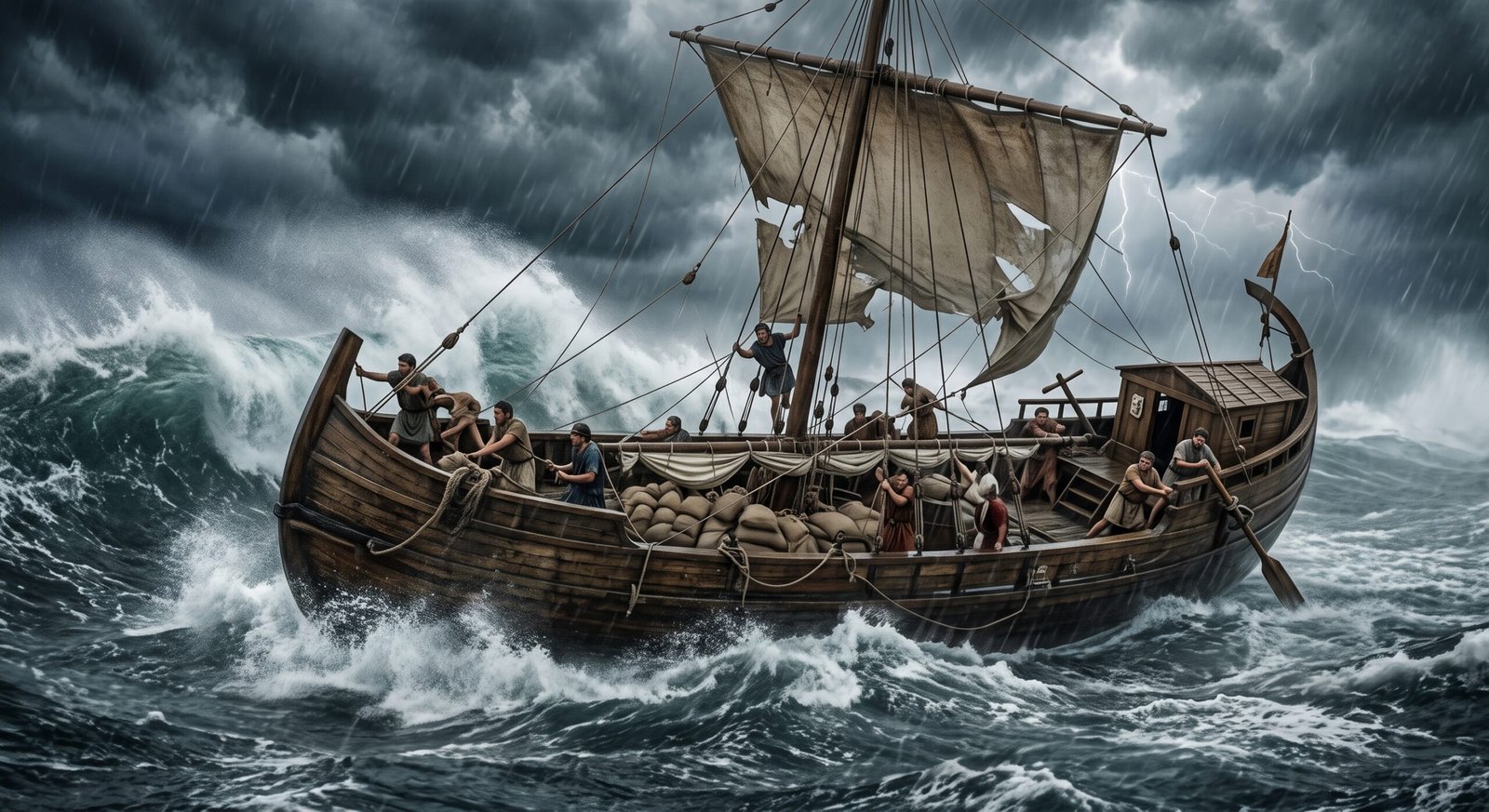
Everything Seeming to Go Wrong While Following God’s Plan
Primary passage for this devotion: Acts 27:1-44
While preparing for this devotion, I did what I normally do. I read the passage and then meditated on it. One thing that immediately stands out is how it is written. Compared to many stories in the Bible and even in Acts, the action moves at a slower pace, and we get a lot of details.
First, we need to understand that Paul’s appearance in Rome was ordained by God.
- In a vision to Ananias in Acts 9:10-15, Ananias is told that Paul will appear before kings.
- Following the riot at the temple and Paul’s arrest by Roman authorities, the Lord appeared to him by night and said, “Take courage, for as you have testified to the facts about me in Jerusalem, so you must testify also in Rome.” Acts 23:11
- Finally, in Acts 27:24, Paul spoke of what an angel had told him: “Do not be afraid, Paul; you must stand before Caesar. And behold, God has granted you all those who sail with you.”
Second, it is important to understand that while Paul was being transported to Rome, he had a lot of protection as a Roman citizen. It was against the law for him to be abused in any way. He also had as much social standing as the centurion. This is why in verse 3 you see Julius greeting him kindly and giving him leave so that Paul’s friends could care for him.
With this in mind, it could have been very possible for Paul to have a very uneventful cruise. At most, he might have been lightly bound, but his care and safety would have been a priority.
But that is not what happens.
Instead of a smooth passage across the Mediterranean, Paul’s journey turned into a grueling, multi-week trial where human calculations failed at every turn. After leaving Sidon, unfavorable westerly winds forced the ship to crawl along the coast of Cilicia and Pamphylia before transferring to an Alexandrian grain freighter at Myra. From there, the vessel made painfully slow headway against prevailing northwesterly gales, finally limping into Fair Havens on the south side of Crete. As weeks slipped away, the autumn weather turned hazardous. Paul explicitly warned the centurion and crew that pressing forward would invite disaster, injury, and heavy loss of cargo. Yet Julius sided with the ship’s pilot and owner, choosing to gamble on reaching a better winter harbor at Phoenix.
That gamble unraveled almost immediately. What began as a gentle south wind quickly gave way to a violent tempest called a northeaster. The hurricane-force winds seized the vessel, driving it entirely out of the crew’s control past the small island of Cauda. In desperate bids to keep the ship afloat, the sailors bound the hull with cables to hold the timbers together, lowered the gear to avoid running aground on the African sandbars, and ran blindly before the gale. By the second day, they were jettisoning valuable cargo. By the third day, the crew threw the ship’s tackle into the sea with their own hands. For many days, neither the sun nor the stars appeared to offer navigation, and Luke recorded the grim psychological breaking point of all aboard: all hope of survival was completely abandoned.
Yet it was precisely at the point of utter hopelessness that God’s sovereign promise stepped into the darkness. While the two hundred and seventy-six men aboard prepared for watery graves, Paul gathered the ship’s company to share the word given to him by the angel of the God to whom he belonged. Paul did not promise an easy way out, nor did he promise that the ship or its cargo would be saved. He announced that the vessel would be destroyed, but that not a single life would be lost, urging them to take heart because God’s word was certain. In the fourteen days they spent adrift on the open Adriatic Sea, terror threatened to scatter them, but Paul insisted everyone remain aboard the vessel. Shortly before dawn, he took bread, thanked God openly in front of them all, and urged everyone to eat for strength, anchoring their terrified hearts with practical faith.
When daylight finally exposed the coastline of Malta, the crew cut away the anchors, unlashed the rudders, hoisted the foresail, and ran the ship aground on a sandbar. Pounded by the relentless surf, the stern quickly broke to pieces. The soldiers planned to kill the prisoners to prevent any escape, but the centurion, determined to keep Paul alive, intervened and stopped them. Julius ordered those who could swim to plunge overboard first, while the rest followed on planks and pieces of wreckage. Just as the Lord had promised, the ship was completely lost, yet every single soul reached the safety of the shore alive.
Acts 27 teaches us that walking squarely in the center of God’s will does not exempt us from the storm. Paul had a clear, divine mandate to testify in Rome, yet the path to that destination involved howling winds, weeks of darkness, human foolishness, and a violent shipwreck. But we need to reconsider the pacing of the account again. The best we can estimate is that this account took from 5 to 7 weeks. Imagine being on board a ship, knowing you are where God wants you to be, yet near death so often. Paul might have even assumed he was being punished for doing what he was told.
But he would have been wrong.
God was not punishing Paul; He was using the storm to put His power on display. If the voyage had been a smooth, routine sail under favorable winds, Paul would have arrived in Rome as just another face in a manifest of prisoners. The centurion, the owner, the crew, and the other captives would have gone on with their lives untouched, and the broader world would have seen only an ordinary transit.
Instead, God chose to display His absolute faithfulness through five to seven weeks of prolonged crisis. By allowing human skill, nautical gear, and survival calculations to be thoroughly stripped away, the Lord created a platform where only His voice could bring hope. The crew did not turn to Paul because of his status; they turned to him because, when all earthly hope was gone, the God he served was the only anchor left.
And we know that for those who love God all things work together for good, for those who are called according to his purpose. Romans 8:28
The answer to why Paul suffered in the storm might be difficult to hear. We often think of Romans 8:28 as a personal guarantee that negative circumstances will soon be exchanged for better circumstances and personal comfort. Sometimes that may happen, but that is not what we are promised. We are promised that our struggle and sacrifices will be rewarded when our time here is up.
In the here and now, however, the good God is working out may be for the benefit of those who are watching us navigate the crisis. What Paul endured became an undeniable witness to two hundred and seventy-six terrified souls and a lasting testimony for generations of believers. It was agonizing to live through, but the story of it made waves of its own and brought glory to God.
I encourage you to read and reread Acts 27 slowly. There is much more to learn there.
For those of you enduring your own tempest, hold fast to this promise:
So we do not lose heart. Though our outer self is wasting away, our inner self is being renewed day by day. 17 For this light momentary affliction is preparing for us an eternal weight of glory beyond all comparison, 18 as we look not to the things that are seen but to the things that are unseen. For the things that are seen are transient, but the things that are unseen are eternal. 2 Corinthians 4:16-18
Similar Posts: